09 December 2009

Batman: The Cult

Jim Starlin truly takes Batman to the edge in back in Batman: The Cult. Investigating a mysterious cult that has taken Gotham by storm, particularly its homeless population, Batman winds up captured and brainwashed in a fight that he barely escapes a live.

What really carries this story is Wrightson and Wray's art. Although the writing is truly incredible, as is typically the case with legend Jim Starlin at the helm, the art in this comic is really unlike anything I have ever seen before in the world of comics.

There is one scene in particular, when Batman, freshly starved, tortured and brainwashed, escapes from his captors and reemerges in Gotham. A three panel spread illustrates his deluded vision of himself: at first a slowly rotting corpse, literally deteriorating to the part of collapse. When we return to Batman, following an interlude, the sequence is repeated with Batman's willpower creating a new vision of himself as a shining knight emerging from the depths. This scene has stuck with me ever since I read this comic and really is something special.

Additionally, this comic, like a select few others, closely examines Batman at the verge of collapse. The visual representation mentioned above is a neat summary, but what really speaks to this notion is the conclusion of this comic. Batman, forced to face down more than half of the population of Gotham, all indoctrinated by the same cult, resorts to a tank like version of the Batmobile equipped with a twin gatling guns firing rubber bullets.

Here we have Batman going against his tenet to never use firearms, but I guess if there's no other way...

Batman: Ego and Other Tales

Darwyn Cooke's soft pencils and muted coloring can't lighten the intesnity of Batman: Ego and Other Tales. Opening with an intense internal conflict between Batman and his "inner demon", Batman, the reader is immediately given insight into Batman's heavily troubled psyche.

The notion of something of a duality between Bruce Wayne and his inner "Batman" is not necessarily new to DC Comics. But perhaps what is so chilling about Cooke's retelling is the innocence and gentle nature of his drawings. Seeing Batman's demonic side is just plain eerie when viewed in this light.

Also of note in this collection is a story that actually does not focus on Batman but rather on Catwoman. Providing the audience with a background not only to Catwoman, but the man who trained her, this story is nothing if not a wild ride through the world of Batman's loveliest supper villainess and only professional love interest.

Batman: A Death in the Family

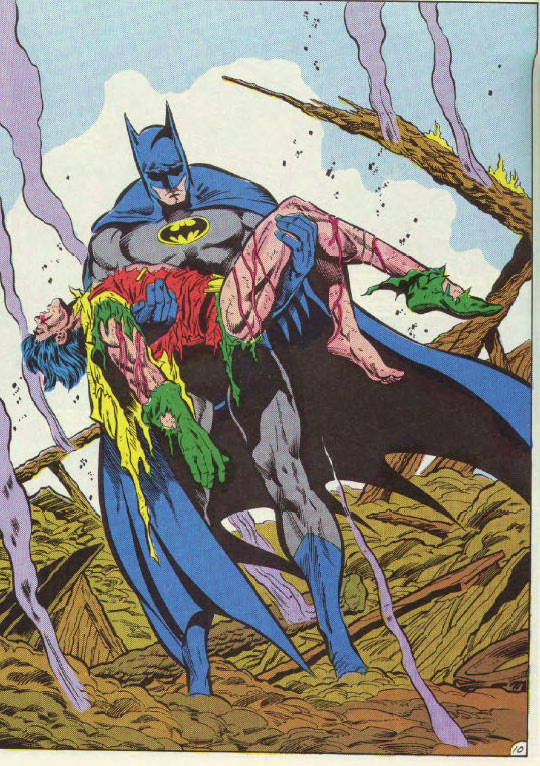
The death of Jason Todd, chronicled in Jim Starlin and Jim Aparo's Death in the Family, is bizarre. Published in the late 80's, this comic goes from strange to the downright weird -- even for an 80's comic.

Jason Todd, Batman's second Robin, following Dick Grayson who went on to become Nightwing, is in search of his birth mother. Following several possible leads, the brash young teen heads off to Africa and the Middle East without informing his mentor and friend, Batman.

Ironically, Batman is following the Joker to the same locales that Jason is searching for his mother. Coincidence? I think not.

As they gradually eliminate their leads, Batman agrees to aid Jason in his quest, the two come to the final woman. In a surprise twist, she is revealed to be working with the Joker, who has forced her to deliver his infamous Joker Gas to unsuspecting refugees.

After a fitting showdown, Jason shields his mother from an exploding bomb and loses his life. This story is something of a bizarre letdown -- or more realistically, a blatant decision by DC to assassinate one of its characters.

Even more bizarre than the story is the fact that Joker winds up becoming the Iranian ambassador to Iran -- but I won't even get in to that. I think it suffices to say that this bizarre tale is a clear cut moment when a publisher makes a decision to remove a character -- why they chose this completely outlandish scenario though, is something I'll never know...

Batman Gothic

DC superstars Grant Morrison and Klaus Janson team up for this dark look into Batman's past and even more disturbing present.

The seemingly unkillable "Mr. Whisper" is prowling the streets of Gotham City and ruthlessly murdering mob bosses. Although he would never admit it, this doesn't seem like it should be a problem for the Dark Knight Detective -- someone is doing his dirty work for him!

But a little digging into the true identity of the elusive Mr. Whisper takes the Caped Crusader somewhere he could never have expected this mystery to lead him: his past! In a cruel twist of fate -- Grant Morrison's specialty -- Mr. Whisper is revealed to be none other than Bruce Wayne's exceedingly cruel headmaster from boarding school. But knowing Morrison, the story can't merely be that simple.

And true to form, it isn't. Mr. Whisper is further revealed to be an occultist who converted a monastery of God fearing men to evil hundreds of years ago, making a deal with the dark lord in exchange for immortality. Although this aspect of the story is truly amazing and a wild adventure into the past and the world of mysticism, it is actually Whisper's seemingly benign headmaster days that raise the most interesting questions about this story.

In a flashback sequence, it would seem as though Morrison implies that while young Bruce Wayne is enrolled in Whisper's boarding school, he is in fact sodomized by Mr. Whisper. This allegation, highly plausible given the context and Whisper's tendency toward extreme perversion, is an anomaly. Never before in all the comics that I have read have I ever read something this controversial. The closest DC has come to something like this is the rape of Sue Dibny in Identity Crisis. Regardless, it added a powerful and unique element to the story that brought a new level of intensity to the usually super intense character of Batman.

Final Crisis: Legion of Three Worlds

DC superstar creative minds Geoff Johns and George Perez join forces for this epic tale of everyone's favorite superhero team from the 31st century: The Legion of Superheroes!

Pit against Superboy Prime, a nearly unstoppable, younger version of Superman from an alternate universe, the Legion of Superheroes from three worlds unite under a single banner to fight this seemingly invincible foe.

Aside from the nonstop action masterfully delivered through Perez's classic art and Johns' humorous and powerful writing, this work explains one of the oldest mysteries in the DC Universe: the identity of the Legion of Superheroes oldest foe, the Time Trapper.

In a wild twist only Geoff Johns could imagine, the Time Trapper is shockingly revealed to be none other than Superboy Prime himself. Whoa, talk about a head trip!

The ever self destructive Superboy Prime proves his own undoing, literally, and winds up defeating himself -- a fitting exit for one of the DCU's most obnoxious characters. But beyond the inherent humor in his downfall, this story takes an intense look at the various incarnations of the Legion throughout the ages and additionally, a deeply personal look, which seems impossible given his vanity, at Superboy Prime.

Cosmic Odyssey

Jim Starlin and Mike Mignola deliver a seminal piece of DC continuity with Cosmic Odyssey. A pivotal tale for all involved - the truly all-star cast includes New Gods Highfather, Orion, Lightray, Forager, Metron and Darkseid; Justice Leaguers Batman, Superman and the Martian Manhunter - this epic tale of the forces of good pitted against evil is perhaps most impactful on John Stewart, the Green Lantern of Earth and all of Sector 2814.

A defining moment in Stewart's career, he makes a brash decision that costs the lives on an entire planet. Sent to Xanshi alongside the Martian Manhunter, the pair must defuse a bomb created by the Anti-Life entity that threatens all of reality. As the planet begins to erupt around the two heroes in enormous spurts of magma, Martian Manhunter is paralyzed -- the direct result of his race's fear of fire. John Stewart creates a protective construct for the Manhunter, using his power ring, and decides to leave him behind and pursue the threat on his own.

Blinded by his own confidence, John Stewart streaks towards the bomb, arriving moments before its detonation only to find his worst and perhaps never considered fears come true: the bomb is yellow, the only weakness to his power ring and Stewart is rendered completely ineffectual.

Shielding himself - as well as the Martian Manhunter - from the blast using his power ring, the population of Xanshi is not as fortunate. With Xanshi utterly decimated and billions of lives extinguished, there is only one direction to point the blame: directly at John Stewart. Ironically, the Martian Manhunter, who, following the blast informed Stewart that he would never forgive him, later dissuades him from committing suicide, and in essence, saves not only his life, but one of the most important heroes in the DCU.

This defining moment in Stewart's career is the direct cause of a marked shift in his character. Gone is the happy go lucky "ring slinger", his carefree attitude replaced by what seems like perpetual sincerity and stoicism. To this day, Stewart remains the most intense of all four of Earth's Green Lanterns and the loss of Xanshi plagues him still.

03 December 2009

HEAVY LIQUID

Heavy Liquid is awesome. Paul Pope, renown underground comic artist / writer, delivers an amazingly original, honest and beautifully drawn story as both writer and illustrator.

The story is, in a word, wild. Paul Pope takes the reader on what seems like a nonstop chase through futuristic New York / Paris and beyond. At first a bit difficult to grasp, the story follows a man known only as S, who is in possession of a mysterious substance called Heavy Liquid. Throughout the story, details about the nature of the liquid are revealed, though mostly obscured and only one thing is immediately clear: everyone wants Heavy Liquid. The only context the reader understands it in is as a drug, which S indulges in rather frequently, but the reality is something much more.

As S is pursued by all manner of characters, gangsters, artists, the government, it eventually becomes clear that Heavy Liquid is much more than a drug. The big reveal is that Heavy Liquid is an extraterrestrial being, that arrived on earth on a meteor. The question becomes: how has S been taking a drug, that is in actuality an animate life form?

19 November 2009

DOMU: A Child's Dream

Katsuhiro Otomo's Domu is haunting. Based on a true story of a series of unresolved deaths, most likely suicides, in a Japanese apartment complex, Otomo lends his own interpretation of the tale, which unsurprisingly includes children with telekenesis -- a staple of his work.

Domu reads like a mystery. The reader gets a good sense of the housing complex, a community unto itself, through the seemingly mundane action that Otomo records therein. This is primarily acheived through second hand accounts of the suicides, provided by residents -- ancillary characters to the main narrative. In this way, the audience is able to develop a multidimensional perspective of the story as it is not only seen through the eyes of the victim, the killer or the police -- as is so often the case in a mystery, but the passerby as well.

And perhaps this is why Domu works so well. One of these passersby, seemingly the most benign of all the characters -- an old man who seems lost in a world of his own senility is actually the source of the malevolence. The old man, completely insane and actually possessing the intellect of a small child, is in reality a powerful psychic who compels random victims to end their own lives. This theme, tele or psychokinesis as Otomo likes to call it, is a key feature of his work, most notably his Akira series.

This theme is not only explored by the old man, the story's antagonist, but by it protagonist as well, a young girl who is a new resident of the complex and secretly a powerful psychokinetic herself. Ultimately she defeats the old man and restores order to the housing complex, but the artfulness of this battle: an old man with the intellect of a child versus an actual child does not escape Otomo and makes for a truly amazing reading experience.

05 November 2009

From Hell

From Hell is one of the finest pieces of illustrated literature ever created. Alan Moore weaves a truly masterful tale, musing on one possible back-story for Jack the Ripper deeply immersed in the occult, supported by Eddie Campbell's art which moves seamlessly between hyper detailed and completely abstract.

One of the most enjoyable facets of From Hell is the way it reads. Unlike most comics, which tend to be heavily action oriented and driven, From Hell is more reminiscent of a novel. Rather than relying on wordless action panels, From Hell is almost more akin to a novel in its dense dialogue. It is through these intense interactions that the characters are fleshed out: by their words rather than their actions.

But the most interesting piece of this book is Sir William Gull's practice of the occult. Charged by the Queen of England to eliminate all evidence of the birth of an illegitimate child by the Prince, William Gull strategically murders all involved in order to fulfill a powerful occult ritual tied to Free Masonry, architecture, Druids and the ancient culture of England. This portion of the novel is truly fantastic. While the story progresses and the reader follows the murders and wonders how this man is going to commit these murders successfully, he is secretly engaged in something infinitely more significant -- namely communicating with the devil.

Again, Alan Moore asserts himself as the foremost author in the field of illustrated literature and in my humble opinion, this piece would have to be his master stroke.

21 October 2009

Infinite Crisis

Infinite Crisis, in many ways a sequel to Crisis on Infinite Earths and supposedly the penultimate crisis in the DC Universe, is centered around the original Superman and Lois Lane of Earth-2 as well as Alexander Luthor of Earth-3 and Superboy. Following Crisis on Infinite Earths, these three characters found themselves in a place they called "heaven", completely separated from the newly formed, singular earth. And it was from their heaven that they looked on and watched the progress of earth post Crisis.

In Infinite Crisis, the onlooking quartet has had enough: They have grown tired of watching the Earth carry on in the manner it has since the Crisis, a manner they find undeserving of the sacrifice they made to allow the singular earth to live. And perhaps more importantly, the original Superman is motivated by his Lois Lane, who is dying as a result of separation from Earth-2.

Again, this crisis follows the same structural pattern of the other crises and similarly leads to the deaths and rebirths of a handful of DC characters. But reading this comic when I did originally and even now, I find myself sufficiently enmeshed in DC continuity to see exactly what purpose this Crisis served in the DCU.

The most obvious goal of this event was to introduce Superboy Prime. Along with Superman, Lois Lane and Alexander Luthor, Prime found the current Earth undeserving of their sacrifice. But unlike Superman and Lois, Prime quickly becomes a great force for evil. And since Crisis, he has played in integral role in DC continuity, namely the Sinestro Corps War and Final Crisis.

In terms of thematic analysis, the most interesting relationship is not between the Trinity (Superman, Wonder Woman and Batman) who have a falling out following Wonder Woman's murder of Maxwell Lord, but rather, the relationship between Batman and Brother Eye.

Brother Eye is a satellite Batman created to monitor and "spy" on metahuman activity. Alexander Luthor gives the satellite sentience and in so doing creates a formidable enemy for the metahuman community. But through it all, Batman never really expresses any sincere regret for his actions. He simply takes action and seeks to end the threat that is Brother Eye. This portrayal, although in many ways fitting of Batman's traditionally cold nature, seems to be lacking and I would've liked to have seen a more developed conflict between not only Batman and Brother Eye, but the superhuman community at large.

Zero Hour: Crisis in Time

Zero Hour is the next major crisis in the DC Universe to follow after Crisis on Infinite Earths. In Zero Hour, Hal Jordan, once "the greatest lantern of them all", has gone mad and after slaying the entire Green Lantern corps and destroying the central power battery on OA, attempts to quite literally remake the DCU to his liking, under the moniker Parallax. At the conclusion of Zero Hour, Hal Jordan is believed dead, not to return to DC continuity in earnest until Geoff Johns' 2004 Green Lantern Rebirth.

This book is pretty standard fare for a DC Crisis and follows what seems to be the general structural pattern of the crises in the DCU:
- In the exposition, a new or rarely seen character (in this case Harbinger) is shown to have unique knowledge of an impending threat to the DCU.
- The heroes from various super teams are the gathered together and informed of the crisis / given tasks to perform in order to thwart it.
- The heroes emerge victorious and several DCU characters have either lost their lives or have been brought back to life.
- And most importantly, the skies turn an unnatural color and are filled with lightning.

But even though this story bears structural similarities to other crises in the DCU, it poses a profound moral dilemma through Parallax. Prior to the events of Zero Hour, Hal Jordan's home city, Coast City (this blog's namesake) was destroyed by the villain Mongul. Upon discovering his home destroyed, Jordan used all of his ring's energy to bring the city back to life -- until his ring ran out of energy. Hal Jordan was reprimanded by the Guardians of the Universe and ordered back to OA for disciplinary action. Jordan returned to OA, but en route he killed every fellow Green Lantern he encountered and ultimately destroyed the central power battery of the Green Lantern Corps. Upon destroying the central power battery, Hal Jordan became Parallax, counted among the most powerful beings in the DCU.

In Zero Hour, Parallax uses his seemingly endless power to remake reality as it was before the crisis. In Crisis on Infinite Earths, the many parallel versions of earth were folded into one and Parallax believes that by undoing this and restoring the multiverse, he will restore his home: Coast City. The whole conflict in Zero Hour is based around the fact that the heroes believe no one should have the power to change reality -- but isn't that exactly what they themselves did in Crisis on Infinite Earths?

15 October 2009

Invasion!

Invasion! is the next major crisis in the DCU, following Crisis on Infinite Earths. An alien alliance, formed by most of the staple alien races in the DCU: the Khunds, the Gil Dishpan, the Okaarans, the Daxamites, the Thanagarians, the Durlans and the Citadelians are all united by the calculating Dominators to launch an attack on Earth, specifically targeted at Earth's metahuman population.

Keith Giffen, the mastermind behind this work, weaves in just about every major plotline and character in DC continuity in this work, moving seamlessly from storyline to storyline as our favorite heroes attempt to repel the alien invasion.

Aside from tying up a few storylines and eliminating several players from the DCU, this story makes an interesting comment on the relationship between Earth and its government and the metahuman population. At the onset of the invasion, the Dominators demand Earth's metahuman population in exchange for Earth's safety. The leaders of the U.N. surprisingly refuse and Superman leads an attack on the alien alliance. The notion that the United Nations would not exchange its metahuman population for the safety of the entire planet bears examination.

So often in the DCU and beyond we are privy to the interactions between human and metahuman, but most of the time their is a certain amount of resentment for metahumans. Most recently, Marvel's Secret Invasion and Civil War titles explore this notion. But it is rare to see metahumans receiving sympathy from their human counterparts.

08 October 2009

Crisis on Infinite Earths

Crisis on Infinite Earths is truly a remarkable piece of sequential art. Marv Wolfmann's brilliant writing and George Perez's truly spectacular art aside, this work symbolizes a singularly unique moment in DC continuity: The first instance of admitted recognition of discontinuity and DC's attempt to rectify the situation.

Prior to Crisis, the DCU was a hodgepodge of various stories and timelines. Multiple stories, often with contradictory elements, would be written of a single character irregardless of contributing to a singular thread of continuity. Recognizing this nearly forty years into their existence, DC sought to rectify this dilemma and did so quite ingeniously: By creating a multiverse, DC was able to explain away the various conflicting storylines as actually taking place in alternate universes. Using Crisis, DC sought to destroy all the other newly created universes, leaving a single, unified timeline. And this is achieved in Crisis on Infinite Earths, but a better question might be how long it really lasted.

Continuity and meta-achievements aside, this book is truly remarkable as a piece of sequential art. To begin with Marv Wolfmann's writing, there is simply no one better. And it's not just his history with the DCU and his intimate knowledge of each character, but what really shines is his ability to narrate so authoritatively, so omnisciently that the story really takes on an almost filmic quality.

And his writing is certainly equalled if not surpassed by George Perez's unbelievable art. Perez can render the classic comic book superhero perfectly, that's a given. But what he really does so brilliantly in this piece are panels. The movement and style of his breakdowns are so awe inspiring that they really complement the apocalyptic grandeur of this piece, elevating it to a scale of cosmic proportions.

For anyone who hasn't read this piece, don't be discouraged by its age, this piece stands alone strongly enough that even a first time reader would get a kick out of it and hopefully be encouraged to pick up more DC.

History of the DC Universe

History of the DC Universe provides a nuts and bolts rundown of the DCU, from creation to the age of heroes. The brainchild of Marv Wolfmann and George Perez, this piece, which actually followed Crisis On Infinite Earths is narrated by Harbinger, a central figure in Crisis.

Beginning with the oldest race in existence, the Oans, the first book traces the development of their species through the Gods of Earth's myhtology and ultimately the New Gods of DC's own invention. This book spins a fascinating tale of what is really less the history and more the underlying mythology behind the DCU.

Marv Wolfman and George Perez are perhaps the most prolific duo in DC History. Their most famous work, Crisis on Infinite Earths was the first of DC's many crises and truly raised the bar for comic book continuity. This book was no different. Wolfman's almost prophetic writing is complemented elegantly by Perez's traditional pencils, masterfully illustrating what is in many ways the holy scripture of the DC Universe.

01 October 2009

Will Eisner's Comics and Sequential Art

Will Eisner's Comics and Sequential Art is hands down the most comprehensive, insightful and intellectually stimulating guide I have read on illustrated literature to date. Eisner focuses on the inner workings of imagery, timing, the frame, expressive anatomy and the creative process in his book; specifically, the way they work together in tandem to drive sequential art. Each chapter is superbly researched and presented eloquently, replete with illustrative examples.

In his chapter on imagery, Eisner describes letters as images. Tracing back the origins of writing to pictographs, he illustrates this point with examples from ancient Chinese and Egyptian as well as his own work, presenting a temporally sound argument that spans thousands of years.

But words are not necessarily more important than images, according to Eisner. He makes the fascinating assertion that "The absence of any dialogue to reinforce action serves to determine the viability of images drawn from common experience", bolstering this claim is his premise that the image takes primacy over text in a piece of sequential art.

In his chapter on timing, Eisner explains "Critical to the success of a visual narrative is the ability to convey time". Although I whole-heartedly agree with this claim, I would modify it slightly: Critical to the success of understanding a visual narrative is the ability to convey time. And Eisner explains quite thoroughly how time can be conveyed in sequential art through frames, text, splashes and myriad other devices.

Perhaps the least interesting chapter in Eisner's book, although highly informative and illustrative nonetheless, is his focus on frames. His description, although helpful to the first time reader, seemed a bit rudimentary. Especially in comparison to his later and quite brilliant explanation of power points within frames and the geometry of emphasis.

On the whole, I found this book to be inspiring. Eisner is as eloquent in his didactic ability as he is talented. For anyone seeking to understand sequential art at a higher level, this is a must read.

24 September 2009

The DC Comics Guide to Writing Comics

Dennis O'Neil's The DC Comics Guide to Writing Comics provides the basic groundwork for anyone interested in learning how to write a comic or simply looking to understand a bit more about the technical aspects of comic book storytelling.

This book is highly similar to Scott McCloud's Guide to Understanding Comics but perhaps less idiosyncratic and more easily understood in that it is contextualized by examples from DC Continuity.

O'Neil's writing style is personal and at times quite humorous. This makes the book extremely enjoyable and seems to detract form the books potentially boring didactic nature. Furthermore, Denny O'Neil is among the most seasoned comic veterans of comic book writing and his personal experience is often drawn upon to personalize and contextualize the topic at hand.

And perhaps it is in this sense that the book really goes beyond McCloud's Guide to Understanding Comics. O'Neil explains devices like "The Levitz Paradigm", a model for managing various subplots and side stories, developed by former DC writer / editor and current DC publisher / vice-president Paul Levitz. O'Neil's anecdotal account of working with Paul Levitz personalizes the "Levitz Diagram" on a level that simply does not exist in McCloud's book.

Additionally, by working within the framework of DC Comics, O'Neil discusses many aspects of "big publishing" that McCloud does not mention. Things like the miniseries, maxiseries and megaseries; continuity and story-arcs are important aspects of the world of comics that are not included in McCloud's book.

Finally, I greatly enjoyed O'Neil's chapters on Creating Drama, Characterization, Story Structure and Script Preparation. These truly allowed for a unique and helpful perspective on the essential elements of comic book storytelling.

03 May 2009

Blankets, AKA Craig Thompson's Wet Dream

Craig Thompson claims that Blankets, his autobiographical graphic novel, is meant to describe "what it feels like to sleep next to someone for the first time". Having read Blankets, I can say with a fair amount of confidence that I never want to sleep next to Craig Thompson. In fact, it's hard for me to imagine someone that would.

Blankets focuses primarily on Thompson's Evangelical Christian upbringing and his struggle with faith and a girl. Although his difficulty finding a place in his community is somewhat compelling and his difficulty establishing and maintaining a relationship with a girl is certainly relatable, I found that his complete detachment from the world around him had a similar affect on me: I felt wholly detached from this character.

Personally, I found Thompson's brother to be more compelling than the protagonist. He similarly seemed to exist in a world detached from reality but somehow seeemed to find contentment. The way he is obscured and only appears at somewhat sporadic intervals allowed for glimpses into Thompson's foil: someone who was in his shoes, but coping.

The art in this story was intriguing, specifically Thompson's linework. His adherence to black and white and use of strong and often wavy lines created a style that complimented the book's sentiment of transience and listlessness nicely. Of particular note were Thompson's panel work and transitions. This is where I think that he truly exhibited his artistic skill, especially in his use of surreal motion and monsters that often broke free of the rigid panels and sprawled across this page.

This book seems to fit the bill perfectly for the angsty teen's required reading list, but for anyone with even the slightest bit of contentment, Blankets may be hard to stomach.

12 April 2009

P R E A C H E R

What do god, violence, vampires and John Wayne have in common? If you said The American Dream, you're right. If you said Preacher, you're also right.

Garth Ennis and Steve Dillon lead the reader on a wild ride through an upside down universe where there really is no god in heaven in the 75 issue National Comic Award winning American epic, Preacher.

Ennis' hyper-violent pseudo-religious-western plays out elegantly against Dillon's soft, but sufficiently detailed pencils. In fact, the unreality of Dillon's somewhat cartoonish characters often serves to enhance the intensity of the violence -- the blank expressions and simple explosions that accompany gunshot wounds or the water cooler spout that ultimately serves as Herr Starr's catheter are two examples that seem to stick out. Needless to say, with Ennis' endless cast of quirky characters and calls for obscene violence -- this is one partnership that works out nicely.

30 March 2009

Y The Last Man

Y The Last Man is a phenomenal epic. From the art to the pacing to the character development, this is one comic that I had trouble putting down.

First of all, I love J.G. Jones' cover art. His lifelike character interpretations, although a divergence from Pia Guerra's softer, more cartoonish style, offer a nice complement to the stories -- often setting the tone for the rest of issue. As a side note, Jones' recent covers for DC's Final Crisis were spectacular, rivaling those of fellow realist Alex Ross.

Pia Guerra's art, although not as lifelike as Jones', certainly holds it own. I found that his subtle attention to detail combined with his cooler color palette did Brian K. Vaughn's writing justice.

An interesting facet of this comic was the pacing / character development. The perpetual cuts in the time, combined with the obscured and often omitted scenes in the story seemed to create the sense that the story was going on even when the reader is not reading.

Additionally, the story seems to be perpetually moving forward. Although that may seem like a trite observation, Vaughn really doesn't skip a beat. Every line of dialogue, even if it is introspective, reveals a new element of the plot and moves the story forward. This onward-ness seems to be a typical element of the serial epic and was reminiscent of "Preacher" and "Walking Dead".

22 March 2009

Batman: The Dark Knight Strikes Again

"Dark Knight Strikes Again" ("DKSA") is one of Frank Miller's crowning achievements. Building off of Dark Knight Returns, he continues to recreate the DC Universe in his terrifying image. And personally, I think it's never looked better.

Captain Marvel is easily my favorite character in this story. The separation of Billy Batson and Captain Marvel is a fascinating concept and one that I had not considered before "DKSA". My favorite Captain Marvel moment comes when he is dying and Wonder Woman asks him where he goes when he says the word SHAZAM and he responds: "Where does a wish go? Where does a dream go when you wake up?" Although to most this must seem incredibly corny, I find that corniness is the most important element of Captain Marvel's character -- one that is frequently played upon in continuity. That's what makes his final words so compelling, he retains Batson's childlike innocence despite their alleged separation.

Frank Miller is an extremely capable comic book artist -- both in his own unique style (demonstrated in "DKSA") and the classic sense. Chris Claremont even went so far as to hail him as one of the most talented comic book artists he has ever worked with (circa the Miller / Claremont run "Wolverine). But it is apparent at first glance that "DKSA" is not illustrated in the classic style. I personally found that his less-than-realistic design style coupled with digital inks perfectly portrayed an edgy, highly emotional, futuristic dreamscape.