09 December 2009

Batman: A Death in the Family

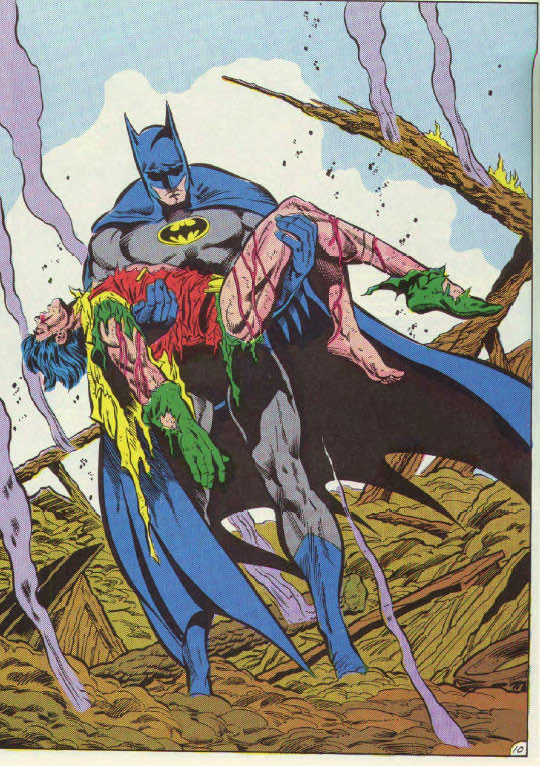
The death of Jason Todd, chronicled in Jim Starlin and Jim Aparo's Death in the Family, is bizarre. Published in the late 80's, this comic goes from strange to the downright weird -- even for an 80's comic.

Jason Todd, Batman's second Robin, following Dick Grayson who went on to become Nightwing, is in search of his birth mother. Following several possible leads, the brash young teen heads off to Africa and the Middle East without informing his mentor and friend, Batman.

Ironically, Batman is following the Joker to the same locales that Jason is searching for his mother. Coincidence? I think not.

As they gradually eliminate their leads, Batman agrees to aid Jason in his quest, the two come to the final woman. In a surprise twist, she is revealed to be working with the Joker, who has forced her to deliver his infamous Joker Gas to unsuspecting refugees.

After a fitting showdown, Jason shields his mother from an exploding bomb and loses his life. This story is something of a bizarre letdown -- or more realistically, a blatant decision by DC to assassinate one of its characters.

Even more bizarre than the story is the fact that Joker winds up becoming the Iranian ambassador to Iran -- but I won't even get in to that. I think it suffices to say that this bizarre tale is a clear cut moment when a publisher makes a decision to remove a character -- why they chose this completely outlandish scenario though, is something I'll never know...

Batman Gothic

DC superstars Grant Morrison and Klaus Janson team up for this dark look into Batman's past and even more disturbing present.

The seemingly unkillable "Mr. Whisper" is prowling the streets of Gotham City and ruthlessly murdering mob bosses. Although he would never admit it, this doesn't seem like it should be a problem for the Dark Knight Detective -- someone is doing his dirty work for him!

But a little digging into the true identity of the elusive Mr. Whisper takes the Caped Crusader somewhere he could never have expected this mystery to lead him: his past! In a cruel twist of fate -- Grant Morrison's specialty -- Mr. Whisper is revealed to be none other than Bruce Wayne's exceedingly cruel headmaster from boarding school. But knowing Morrison, the story can't merely be that simple.

And true to form, it isn't. Mr. Whisper is further revealed to be an occultist who converted a monastery of God fearing men to evil hundreds of years ago, making a deal with the dark lord in exchange for immortality. Although this aspect of the story is truly amazing and a wild adventure into the past and the world of mysticism, it is actually Whisper's seemingly benign headmaster days that raise the most interesting questions about this story.

In a flashback sequence, it would seem as though Morrison implies that while young Bruce Wayne is enrolled in Whisper's boarding school, he is in fact sodomized by Mr. Whisper. This allegation, highly plausible given the context and Whisper's tendency toward extreme perversion, is an anomaly. Never before in all the comics that I have read have I ever read something this controversial. The closest DC has come to something like this is the rape of Sue Dibny in Identity Crisis. Regardless, it added a powerful and unique element to the story that brought a new level of intensity to the usually super intense character of Batman.

Final Crisis: Legion of Three Worlds

DC superstar creative minds Geoff Johns and George Perez join forces for this epic tale of everyone's favorite superhero team from the 31st century: The Legion of Superheroes!

Pit against Superboy Prime, a nearly unstoppable, younger version of Superman from an alternate universe, the Legion of Superheroes from three worlds unite under a single banner to fight this seemingly invincible foe.

Aside from the nonstop action masterfully delivered through Perez's classic art and Johns' humorous and powerful writing, this work explains one of the oldest mysteries in the DC Universe: the identity of the Legion of Superheroes oldest foe, the Time Trapper.

In a wild twist only Geoff Johns could imagine, the Time Trapper is shockingly revealed to be none other than Superboy Prime himself. Whoa, talk about a head trip!

The ever self destructive Superboy Prime proves his own undoing, literally, and winds up defeating himself -- a fitting exit for one of the DCU's most obnoxious characters. But beyond the inherent humor in his downfall, this story takes an intense look at the various incarnations of the Legion throughout the ages and additionally, a deeply personal look, which seems impossible given his vanity, at Superboy Prime.

Cosmic Odyssey

Jim Starlin and Mike Mignola deliver a seminal piece of DC continuity with Cosmic Odyssey. A pivotal tale for all involved - the truly all-star cast includes New Gods Highfather, Orion, Lightray, Forager, Metron and Darkseid; Justice Leaguers Batman, Superman and the Martian Manhunter - this epic tale of the forces of good pitted against evil is perhaps most impactful on John Stewart, the Green Lantern of Earth and all of Sector 2814.

A defining moment in Stewart's career, he makes a brash decision that costs the lives on an entire planet. Sent to Xanshi alongside the Martian Manhunter, the pair must defuse a bomb created by the Anti-Life entity that threatens all of reality. As the planet begins to erupt around the two heroes in enormous spurts of magma, Martian Manhunter is paralyzed -- the direct result of his race's fear of fire. John Stewart creates a protective construct for the Manhunter, using his power ring, and decides to leave him behind and pursue the threat on his own.

Blinded by his own confidence, John Stewart streaks towards the bomb, arriving moments before its detonation only to find his worst and perhaps never considered fears come true: the bomb is yellow, the only weakness to his power ring and Stewart is rendered completely ineffectual.

Shielding himself - as well as the Martian Manhunter - from the blast using his power ring, the population of Xanshi is not as fortunate. With Xanshi utterly decimated and billions of lives extinguished, there is only one direction to point the blame: directly at John Stewart. Ironically, the Martian Manhunter, who, following the blast informed Stewart that he would never forgive him, later dissuades him from committing suicide, and in essence, saves not only his life, but one of the most important heroes in the DCU.

This defining moment in Stewart's career is the direct cause of a marked shift in his character. Gone is the happy go lucky "ring slinger", his carefree attitude replaced by what seems like perpetual sincerity and stoicism. To this day, Stewart remains the most intense of all four of Earth's Green Lanterns and the loss of Xanshi plagues him still.

03 December 2009

HEAVY LIQUID

Heavy Liquid is awesome. Paul Pope, renown underground comic artist / writer, delivers an amazingly original, honest and beautifully drawn story as both writer and illustrator.

The story is, in a word, wild. Paul Pope takes the reader on what seems like a nonstop chase through futuristic New York / Paris and beyond. At first a bit difficult to grasp, the story follows a man known only as S, who is in possession of a mysterious substance called Heavy Liquid. Throughout the story, details about the nature of the liquid are revealed, though mostly obscured and only one thing is immediately clear: everyone wants Heavy Liquid. The only context the reader understands it in is as a drug, which S indulges in rather frequently, but the reality is something much more.

As S is pursued by all manner of characters, gangsters, artists, the government, it eventually becomes clear that Heavy Liquid is much more than a drug. The big reveal is that Heavy Liquid is an extraterrestrial being, that arrived on earth on a meteor. The question becomes: how has S been taking a drug, that is in actuality an animate life form?

19 November 2009

DOMU: A Child's Dream

Katsuhiro Otomo's Domu is haunting. Based on a true story of a series of unresolved deaths, most likely suicides, in a Japanese apartment complex, Otomo lends his own interpretation of the tale, which unsurprisingly includes children with telekenesis -- a staple of his work.

Domu reads like a mystery. The reader gets a good sense of the housing complex, a community unto itself, through the seemingly mundane action that Otomo records therein. This is primarily acheived through second hand accounts of the suicides, provided by residents -- ancillary characters to the main narrative. In this way, the audience is able to develop a multidimensional perspective of the story as it is not only seen through the eyes of the victim, the killer or the police -- as is so often the case in a mystery, but the passerby as well.

And perhaps this is why Domu works so well. One of these passersby, seemingly the most benign of all the characters -- an old man who seems lost in a world of his own senility is actually the source of the malevolence. The old man, completely insane and actually possessing the intellect of a small child, is in reality a powerful psychic who compels random victims to end their own lives. This theme, tele or psychokinesis as Otomo likes to call it, is a key feature of his work, most notably his Akira series.

This theme is not only explored by the old man, the story's antagonist, but by it protagonist as well, a young girl who is a new resident of the complex and secretly a powerful psychokinetic herself. Ultimately she defeats the old man and restores order to the housing complex, but the artfulness of this battle: an old man with the intellect of a child versus an actual child does not escape Otomo and makes for a truly amazing reading experience.

05 November 2009

From Hell

From Hell is one of the finest pieces of illustrated literature ever created. Alan Moore weaves a truly masterful tale, musing on one possible back-story for Jack the Ripper deeply immersed in the occult, supported by Eddie Campbell's art which moves seamlessly between hyper detailed and completely abstract.

One of the most enjoyable facets of From Hell is the way it reads. Unlike most comics, which tend to be heavily action oriented and driven, From Hell is more reminiscent of a novel. Rather than relying on wordless action panels, From Hell is almost more akin to a novel in its dense dialogue. It is through these intense interactions that the characters are fleshed out: by their words rather than their actions.

But the most interesting piece of this book is Sir William Gull's practice of the occult. Charged by the Queen of England to eliminate all evidence of the birth of an illegitimate child by the Prince, William Gull strategically murders all involved in order to fulfill a powerful occult ritual tied to Free Masonry, architecture, Druids and the ancient culture of England. This portion of the novel is truly fantastic. While the story progresses and the reader follows the murders and wonders how this man is going to commit these murders successfully, he is secretly engaged in something infinitely more significant -- namely communicating with the devil.

Again, Alan Moore asserts himself as the foremost author in the field of illustrated literature and in my humble opinion, this piece would have to be his master stroke.